A VA loan is a mortgage from a regular lender that the Department of Veterans Affairs partly guarantees, which is why most eligible buyers can purchase with no down payment and no monthly mortgage insurance. To use one, you need a Certificate of Eligibility, you have to qualify with the lender on credit and income, and you have to plan to live in the home. Most buyers pay a one-time VA funding fee, but veterans getting VA disability compensation and some surviving spouses don't pay it at all.
That's the short version. In Hampton Roads, with Naval Station Norfolk, NAS Oceana, Little Creek, Dam Neck, and the shipyards all close by, we work with a lot of buyers using this benefit. Here's how it actually works, along with what sellers should know when a VA offer comes in.
Who can get a VA loan?
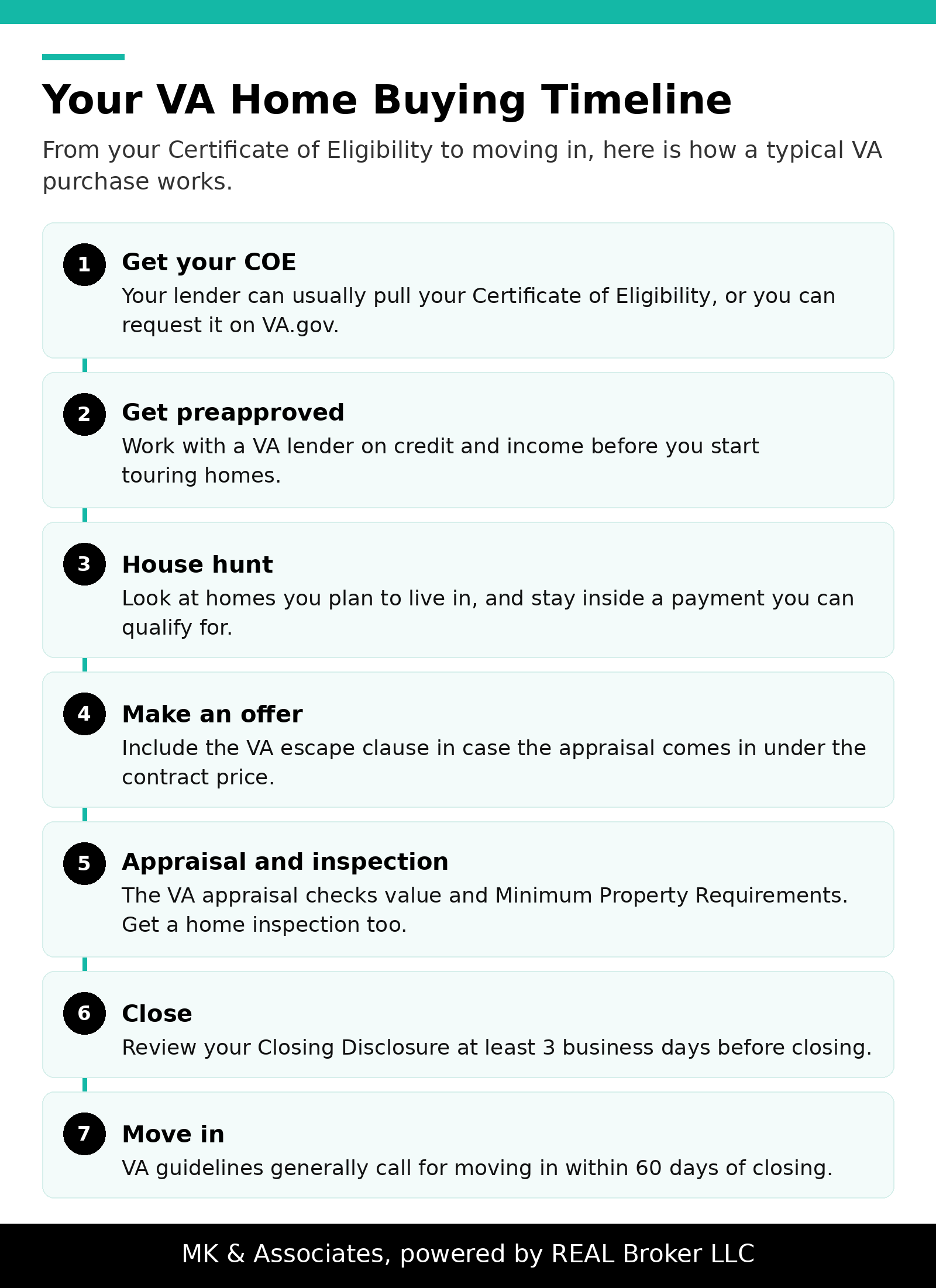
You need a Certificate of Eligibility, usually called a COE. It shows your lender you qualify for the benefit based on your service. Most lenders can pull it for you online, or you can request it yourself on VA.gov.
For most people buying today, these are the basic service requirements:
- Active duty. At least 90 continuous days of service.
- Veterans who served after August 2, 1990. Usually 24 continuous months, or the full period you were called to active duty (at least 90 days). If you were discharged for a service-connected disability, you can qualify with less time.
- National Guard and Reserve. At least 90 days of qualifying active duty, or 6 creditable years of service.
- Surviving spouses. You may qualify if you're eligible for or receiving certain types of Dependency and Indemnity Compensation (DIC), or if your spouse is missing in action or a prisoner of war.
Older service periods have different rules, and there are exceptions for things like hardship discharges. If you're not sure where you fall, VA's eligibility page spells out every period, or a VA lender can check for you.
Do I really not need a down payment?
If you have your full entitlement, most lenders won't require a down payment. Full entitlement means you've never used the benefit, or you used it and got it restored.
Since 2020, buyers with full entitlement don't have a VA loan limit. You still have to qualify for the payment, and the loan can't be more than the home's appraised value or the purchase price, whichever is lower.
If part of your entitlement is still tied up in another home, your no-down-payment amount is based on the county loan limit and how much entitlement you have left. That's common for military families who kept their last house as a rental. Your lender can run the numbers with you.
You can also put money down if you want to. It lowers your loan amount and can lower your funding fee.
Is there mortgage insurance on a VA loan?
No. VA loans don't have private mortgage insurance (PMI) or the mortgage insurance premium that FHA loans charge. On a conventional loan with less than 20% down, PMI is usually part of your monthly payment, so this can make a real difference in what you can afford.
VA also doesn't set a minimum credit score. Individual lenders do set their own, so if one lender turns you down, it's worth talking to another.
What is the VA funding fee, and do I have to pay it?
The funding fee is a one-time charge paid to VA. It's figured as a percentage of your loan amount, and you can pay it at closing or roll it into the loan.
Here are the current rates for purchase loans:
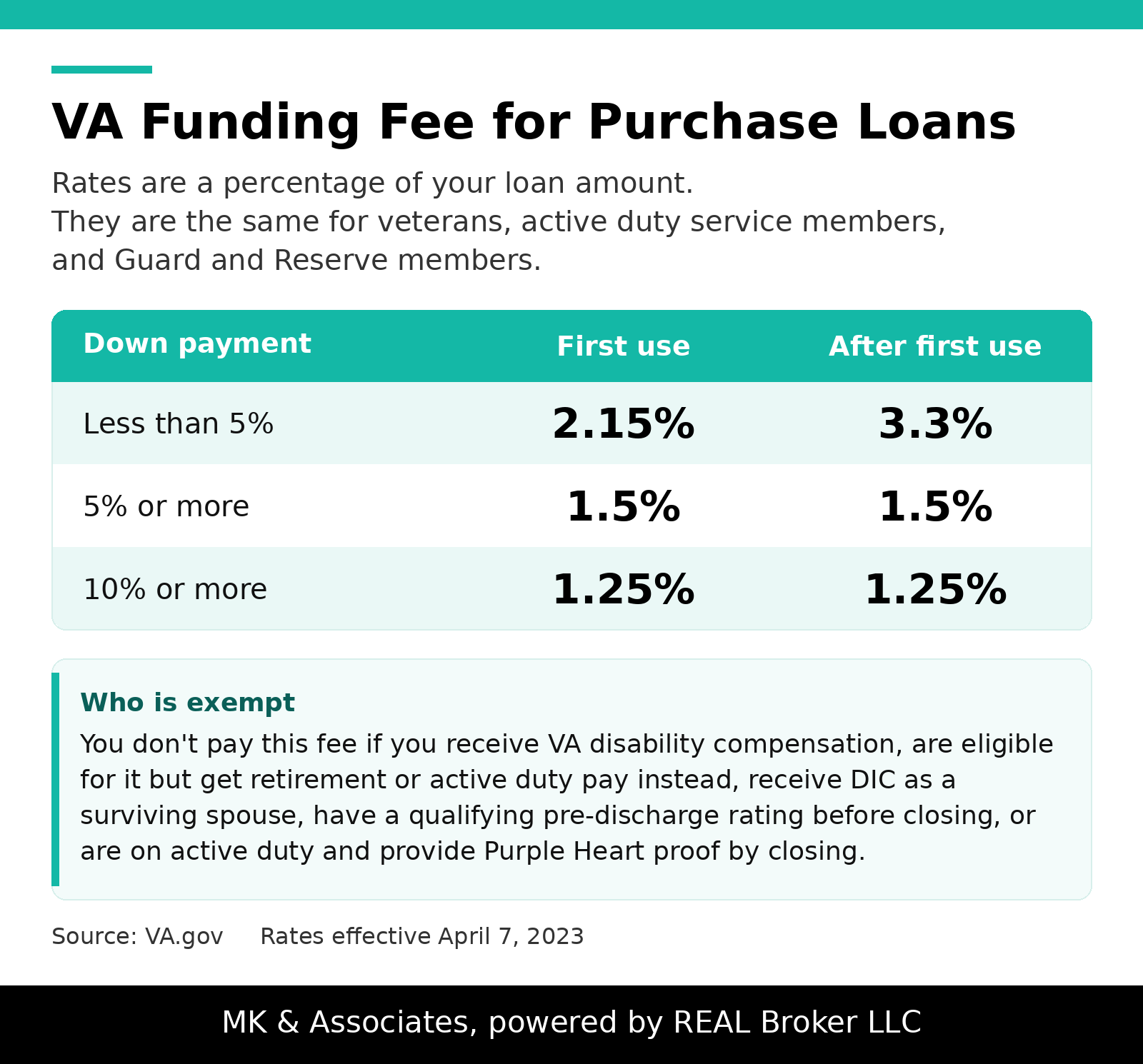
| Down payment | First time using the benefit | After first use |
|---|---|---|
| Less than 5% | 2.15% | 3.3% |
| 5% or more | 1.5% | 1.5% |
| 10% or more | 1.25% | 1.25% |
These rates are the same for veterans, active duty service members, and Guard and Reserve members.
You don't pay the funding fee if any of these apply to you:
- You receive VA compensation for a service-connected disability.
- You're eligible for disability compensation but are getting retirement or active duty pay instead.
- You're a surviving spouse receiving DIC.
- You're a service member with a proposed or memorandum rating, issued before closing, that says you're eligible for compensation based on a pre-discharge claim.
- You're on active duty and show proof, on or before closing day, that you received a Purple Heart.
If you pay the fee and VA later awards you disability compensation with an effective date before your closing, you may be able to get the fee refunded. That's worth knowing if you have a claim in process when you buy.
Do I have to live in the home?
Yes. A VA purchase loan is for a home you'll live in. VA's lender guidelines say you generally need to move in within 60 days of closing. A later date can work in some cases, like a planned retirement, as long as there's a specific date and a specific reason.
This part matters for military families. If you're on active duty and can't move in yet, your spouse or dependent child living in the home can meet the requirement. And if you're deployed away from your permanent duty station, VA treats that as temporary duty, so you can still meet the occupancy rule.
Once you've lived there, you can PCS and rent the house out later. VA's own handbook uses that exact example: a veteran who lived in the home, got orders overseas, and rented it out.
What does the VA appraisal check?
A VA appraiser does two jobs. They give an opinion of value, and they check the home against VA's Minimum Property Requirements, or MPRs. MPRs are about making sure the home is safe, structurally sound, and sanitary. Think working water, hot water, a safe sewage system, and no major safety or structural problems.
If something doesn't meet MPRs, the appraisal comes back "subject to" repairs, and those repairs have to be done before the loan can close. Cosmetic stuff like worn carpet or dated paint isn't supposed to be called out.
The appraisal is not a home inspection. VA strongly recommends getting one anyway, and we agree. Our post on the biggest home inspection red flags covers what to watch for.
What happens if a VA appraisal comes in low?
There's a process for this that started right here in Hampton Roads. It's called the Tidewater process, because VA first tried it out in the Tidewater area of Virginia.
If the appraiser thinks the value will come in under the contract price, they have to contact the point of contact listed on the appraisal order, often the agent or loan officer, before finishing the report. That person then has two business days to send over sales that support the price. A good agent has those comps ready.
If the value still comes in low, the buyer has a few options:
- Ask for a Reconsideration of Value with better sales data.
- Renegotiate the price with the seller.
- Pay the difference in cash at closing.
Your contract should also include the VA escape clause. It lets you get out of the deal if the home doesn't appraise for the contract price.
What closing costs will I pay on a VA loan?
VA limits what lenders can charge you. A lender can charge a flat fee of up to 1% of the loan amount to cover its origination costs. On top of that, you can pay reasonable and customary costs like the appraisal, credit report, title work, recording fees, and your share of taxes and insurance.
On a purchase, the only cost you can roll into the loan is the funding fee. Everything else gets paid at closing, by you, by the seller, or with help from a lender credit. Our post on understanding cash to close walks through how that total comes together.
Your lender has to give you a Closing Disclosure at least 3 business days before closing, so you'll have time to check the numbers.
What should sellers know about VA offers?
If you're selling in Hampton Roads, you're going to see VA offers. Here's what matters on your side.
Seller concessions are capped at 4%, but closing costs don't count toward it. VA has no limit on a seller paying the buyer's normal closing costs. The 4% cap, based on the home's VA appraised value, covers extras like paying the buyer's funding fee, prepaying their taxes and insurance, paying off their debts, or paying for a rate buydown beyond normal discount points.
The appraisal also checks condition. If something doesn't meet MPRs, it'll need to be fixed before closing. If your home has a known safety issue, like a roof leak or a broken handrail, it's usually easier to handle it before you list.
A low appraisal isn't automatically the end of the deal. The Tidewater process gives your agent a chance to send the appraiser supporting sales. Price it right from the start and this rarely comes up. Our post on why overpricing your home is a costly mistake explains why.
If you have a VA loan yourself, a buyer may be able to assume it. VA loans are assumable, and the buyer pays a 0.5% funding fee to take it over. Just know that unless the buyer is an eligible veteran who substitutes their own entitlement, your entitlement can stay tied to that loan. Talk with your lender before you agree to an assumption.
Can I use my VA loan more than once?
Yes. There's no limit on how many times you can use the benefit. You can get your full entitlement back if you sell the home and pay off the loan, or if a qualified veteran assumes your loan and substitutes their entitlement. You can also restore it one time if you pay the loan off but keep the house.
If you keep your current home and don't restore your entitlement, you may still have enough left over to buy again. That's how a lot of Navy families end up with a rental in Virginia Beach or Chesapeake after a PCS.
Down the road, if rates drop, an Interest Rate Reduction Refinance Loan (IRRRL) lets you refinance an existing VA loan into a lower rate. The funding fee on an IRRRL is 0.5%, and you only have to certify that you live in the home now or used to.
Frequently asked questions
Can I use a VA loan to buy a condo? Yes, if the condo project is approved by VA or gets a waiver. Have your lender check the project before you write an offer.
Can I buy a duplex or fourplex with a VA loan? Yes. VA loans can be used on homes with up to 4 units, as long as you live in one of them.
Can a seller pay all of my closing costs on a VA loan? They can. VA doesn't limit a seller paying normal closing costs. The 4% cap only applies to concessions like the funding fee, prepaid taxes and insurance, or paying off your debts.
Do surviving spouses pay the VA funding fee? Not if you're receiving Dependency and Indemnity Compensation as the surviving spouse of a veteran.
Do I need my COE before I start looking at homes? It helps to have it early. Most lenders can pull it in minutes during preapproval, and you should get preapproved before you start touring homes anyway.
Can I rent out my home later if I get PCS orders? Generally yes, once you've lived in it as your home. Many military families do exactly that. Just confirm the details with your lender if you're planning it ahead of time.
Ready to talk through your VA loan options?
Our team helps military families, veterans, and first-time buyers all over Hampton Roads, and we've walked a lot of buyers through VA appraisals and the Tidewater process. If you're getting ready for a PCS, thinking about buying your first home, or selling and want to understand a VA offer, reach out to our team and we'll help you figure out next steps.
You can also run some numbers with our affordability calculator, or check whether a Virginia Beach address sits in a noise zone with our AICUZ lookup by address. If you're moving near Oceana, our post on AICUZ noise zones in Virginia Beach is worth a read too.
MK & Associates, powered by REAL Broker LLC